
Over the past few years, the way people live, shop and spend has changed fundamentally. Digital-first habits, rising expectations around convenience, and greater sensitivity to value have reshaped how consumers engage with brands – often across multiple channels and moments, rather than through a single transaction.
What’s striking is not where people spend, but how deliberately they do so. Consumers increasingly expect choice, immediacy, and relevance, whether they are purchasing for themselves or receiving value from a brand. They move fluidly between physical and digital environments, and they expect brands to meet them consistently across those touchpoints.
From my perspective, gift cards offer one of the clearest windows into this behaviour. They sit directly at the intersection of intent, flexibility, and spend. When you look at how gift cards are used – how quickly they are redeemed, where they are spent, and through which channels – they reveal how people actually interact with value in real life.
This is why a thoughtful gift card strategy matters. For retailers and brands, gift cards are not simply a transactional product, but a tool that enables meaningful engagement across the customer journey. A well-designed program allows brands to engage with customers in the right way – consistently, flexibly, and across channels – ensuring every touchpoint reflects how people truly live and spend today.
By Alec Donald
Retail Vertical Lead & Gift card Expert
Edenred Payment Solutions
A perspective shaped by experience
Earlier in my career, gift cards were often positioned as convenient, easy to deploy, and operationally efficient — useful, but not necessarily strategic. Over time, that has changed.
What has become increasingly clear is that mature gift card programs consistently deliver demonstrable value for brands. These brands don’t treat gift cards as a side offering; they invest in them – through technology, dedicated resources, and sustained promotion – because they see the long-term impact on customer engagement and growth. In many cases, gift cards are no longer maintained; they are actively developed.
What shifted is not a single market trend, but consistent innovation and new use cases for gift cards - across different industries and economic cycles. We saw meal vouchers play a critical role during the pandemic, supporting everyday spending when flexibility mattered most.
We’ve seen digital gift card offering become increasingly personalised, aligning more closely with individual preferences and behaviours. Then, more recently, fintech use cases have opened up new possibilities, showcasing their role as enablers for cashback and alternative value exchanges.
What ties these changes together is a broader shift in how gift cards are understood. They are enabling real consumer value rather than being viewed through the narrow lens of breakage. In fact, a high redemption rate is often a sign of a healthy gift card program. It indicates a strong customer experience, meaningful engagement with the brand, and an offering that genuinely resonates.
"Today, I’m a strong advocate for gift card propositions because of how much value such a simple instrument can unlock when it’s designed thoughtfully."
Through my work at Edenred Payment Solutions, I’m able to look at gift cards through multiple lenses: as a payment mechanism, a source of behavioural insight, and a strategic product that retailers and brands should no longer overlook.
That combination —simplicity on the surface, sophistication beneath it — is what makes gift cards so compelling right now.

Market signals: What the data tells us
When we look across gift card usage at scale, several signals stand out. These are observations, not conclusions — but each tells a story about how consumers engage with brands and where retailers have an opportunity to create impact.
 Physical gift cards remain surprisingly powerful
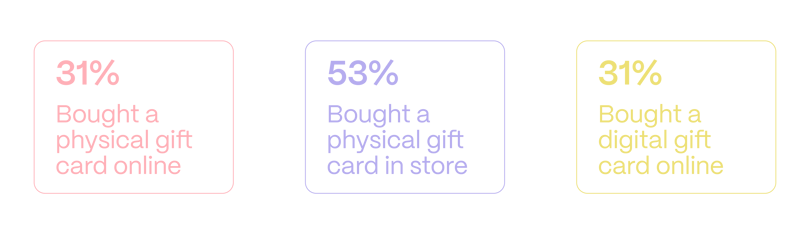
Digital gift cards have grown rapidly over the past few years -accelerated by the pandemic and by digital-first categories like gaming. But what continues to stand out is that, during gifting periods, consumers still expect and value physical gift cards.
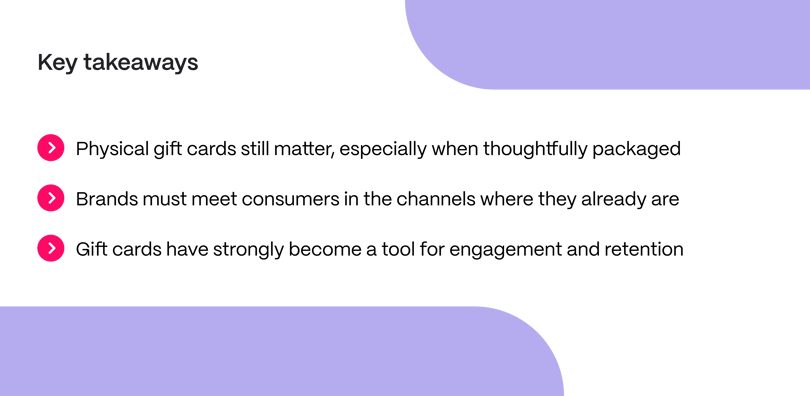
There’s a perception of thoughtfulness attached to something tangible. GCVA data reflects this clearly: more than half of Christmas 2025 gift card purchases (53.4%) were made in store, and almost 40% of purchasers said they bought a gift card because they knew it was exactly what the recipient wanted. That’s a strong signal that while digital has continued to grow, in key gifting periods, consumers are looking for physical gift cards – meaning they are not a compromise, but often a deliberate choice.
For retailers and brands that sell primarily through their own channels, physical gift cards play another important role: they open up new customer touchpoints through third-party distribution. In that sense, a gift card becomes a lever for customer acquisition, not just a gifting product.
Packaging innovation has also played a part here. Gift cards today are far removed from the flat, impersonal cards of the past. From gift boxes to designs that resemble a real present, brands have worked hard to address lingering perceptions. The fact that only 19% of consumers still cite gift cards as feeling impersonal highlights both how far the category has come — and the opportunity that still exists for brands willing to invest in the experience.
Self-use is becoming a major growth driver
Another trend I see very clearly is the rise of gift card purchases for self-use. Consumers are using gift cards as a way to manage value - whether that’s accessing cashback, securing discounts, or budgeting flexibility.
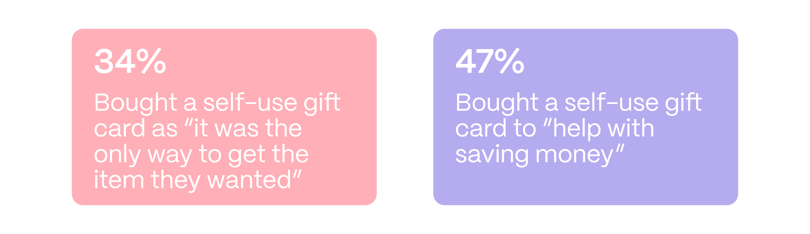
GCVA data shows this isn’t a marginal behaviour. In December 2025, nearly half of those purchasing gift cards for self-use (47.6%) said they did so to help save money. 34% of consumers also purchased gift cards for self-use due to being the only way to access the product they truly wanted. To me, this reflects a broader change in how brand loyalty is formed — value, flexibility, and convenience are increasingly driving decisions.
Self-use is particularly pronounced in the entertainment and gaming industry. For many younger consumers - especially teenagers without debit accounts - stored value is the primary way to access gaming and streaming services. Ten years ago, brands like Amazon or Netflix barely featured in the gift card landscape. Today, they account for a significant share of the market, naturally skewing usage toward self-purchase rather than gifting.
This has important implications for distributors and brands alike. Meeting consumers where they already are - in the channels they use and trust - becomes critical.
Purchasers are planning earlier and buying with intent
Timing is another area where behaviour has changed noticeably. Consumers are buying gift cards earlier in the season and with clearer intent than before. GCVA data shows that 53% of Christmas 2025 gift card purchasers bought in the first half of December, with only 37% leaving it to the final week.
What’s notable here is the move away from last-minute or panic buying. Gift cards are increasingly chosen because they are wanted, not because they are a fallback. This is reinforced by the fact that nearly 40% of purchasers said they selected a gift card because they knew it was what the recipient wanted, while only around a quarter turned to gift cards because they struggled to choose a physical alternative.
For retailers, this matters. Gift cards can play a strategic role not just at the point of purchase, but across the wider customer journey - including returns and exchanges - helping brands retain value and maintain engagement without introducing friction.
What to consider in the next 12 months for programs that drive value and growth
As these patterns evolve, the opportunity for retailers and brands doesn’t lie in reacting to individual trends, but in taking a more deliberate, strategic approach to gift card programs as a whole.
Based on what I’m seeing across the market, three areas will matter most over the next 12 months.
 Move beyond sales metrics and understand true program performance
The first priority is gaining a clear view of how a gift card program is actually performing – not just in terms of volume sold, but in how customers are engaging with it.
That means understanding where gift cards are being purchased, how quickly they get redeemed, and how usage differs between gifting and self-use. These insights reveal far more about customer intent and experience than topline figures alone. For retailers, this level of visibility is what turns a gift card program from a transactional add-on into a meaningful source of data.
 Treat gift card liability as an active strategic consideration
Gift cards sit at an interesting intersection between finance and customer experience. While they represent deferred revenue on the balance sheet, they also reflect future engagement with the brand.
Over the next year, brands will need to be more intentional about how they manage this liability – not simply from a reporting perspective, but in how gift cards are designed, distributed, and redeemed. Programs that encourage healthy redemption and repeat engagement tend to deliver more long-term value than those optimised purely around breakage.
 Design self-use strategies that balance growth and margin
Self-use is now a material part of the gift card ecosystem, particularly in categories like entertainment, gaming, and employee benefits. The challenge for retailers is not whether to support self-use, but how to do so in a way that delivers a clear return on investment.
That requires careful consideration of incentives, discounts, and cashback mechanics – and an understanding of when these drive genuine customer acquisition and retention, versus when they simply subsidise existing behaviour. The most effective programs are those that strike a balance: enabling value for customers while protecting margin and supporting sustainable growth.

Over the next 12 months, the most successful gift card schemes will be those designed with intent – grounded in data, aligned with how customers actually behave, and managed as a strategic asset rather than a transactional product.
For retailers and brands willing to invest in understanding performance, managing liability thoughtfully, and designing strategies with clear commercial outcomes in mind, they offer a powerful way to engage customers at every touchpoint.
In practice, this is where gift card programs start to differentiate – not on availability alone, but on how effectively they support customer engagement across channels.
|
About the expert
With deep visibility into spending patterns, redemption behaviour, and evolving reward strategies, Alec provides market-level insight into how gift card usage is changing — and what that means for businesses.
|



*Unless stated otherwise, all data points have been sourced through the Gift Card & Voucher Association.
Follow Edenred Payment Solutions on Linkedin
Stay up to date with the latest news and learn more about what we do


.png?height=418&name=Blog%20banner%20(UK).png)